
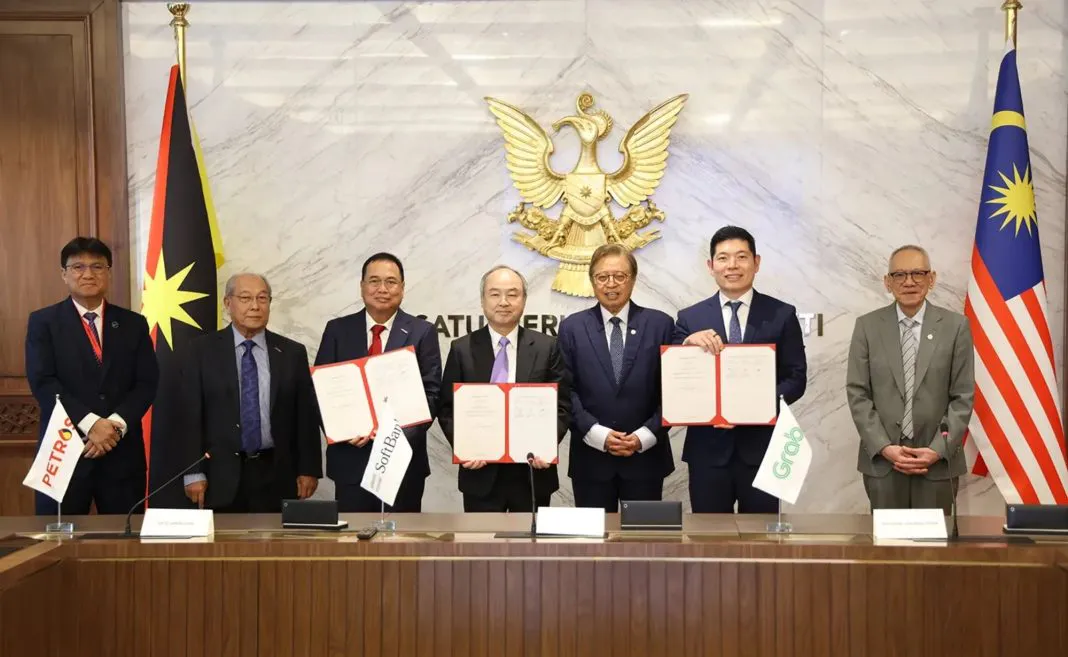
SoftBank Group Corp, Grab Holdings Ltd and Petroleum Sarawak Bhd have committed US$1.85 billion in initial combined seed capital to build AI infrastructure across Sarawak and Peninsular Malaysia, The Edge Malaysia reported.
The sum splits into US$1 billion for Sarawak and US$850 million for Peninsular Malaysia. Both projects will be built with global hyperscalers, which the partners expect to bring in as customers.
The joint development agreements build on a framework deal signed in Kuching on 8 October, and move the partnership into its next phase.
Sarawak’s US$1 billion comprises US$800 million from SoftBank Group, US$100 million from Grab and US$100 million from PETROS. In Peninsular Malaysia, Grab contributes US$650 million and SoftBank Group the remaining US$200 million, the joint statement said.
“This infrastructure will allow us to accelerate the development of localised AI solutions for our communities,” Anthony Tan, Grab’s co-founder, chairman and chief executive officer, said in comments published by Malay Mail. “Through this partnership, we can drive faster regional AI development and adoption, bringing its transformative benefits to many millions of people.”
The deal sits inside a larger SoftBank bet on Malaysia: Prime Minister Anwar Ibrahim confirmed last month that the Japanese group is behind a previously announced US$50 billion investment in the country’s technology sector, a commitment covering AI, emerging technologies and data centre projects, Lowyat.net noted. Chairman and chief executive Masayoshi Son had identified Kuching and several sites in the peninsula for the developments.
The partnership targets five gigawatts or more of AI compute capacity over the long term. SoftBank Group holds the majority stake in the Sarawak project, while Grab has an option to raise its share, a move that would dilute SoftBank but leave it the largest holder.
Grab leads the Peninsular Malaysia project as founding shareholder and expects later funding through third-party equity and non-recourse project financing. Tan is expected to oversee both projects and appoint management teams for day-to-day operations, an arrangement the Grab board has approved.
SoftBank Group has also agreed in principle to a five-year lock-up on Grab shares held directly by one of its entities.
Capital will be released in stages, tied to development milestones, customer contracts and closing conditions. The partners will look for more investors and hyperscaler customers as the projects scale.
Once running, the facilities are expected to rank among the largest AI infrastructure of their kind in Asia. Work will run with the federal government and the Sarawak government, in line with the National AI Action Plan 2026-2030 and Sarawak’s Post Covid-19 Development Strategy 2030.
PETROS brings energy and infrastructure experience to the table. As master developer of the Kuching Low-Carbon Hub, it is assembling upstream development, carbon capture, LNG-to-power, downstream processing, industrial parks, gas terminals and deep-sea port infrastructure, alongside its work on the Sarawak Gas Roadmap.
The partners said the facilities will follow Malaysia’s renewable energy guidelines and use designs built to cut water use and draw less on local power grids. None of the companies disclosed a construction timeline or named the sites involved.