
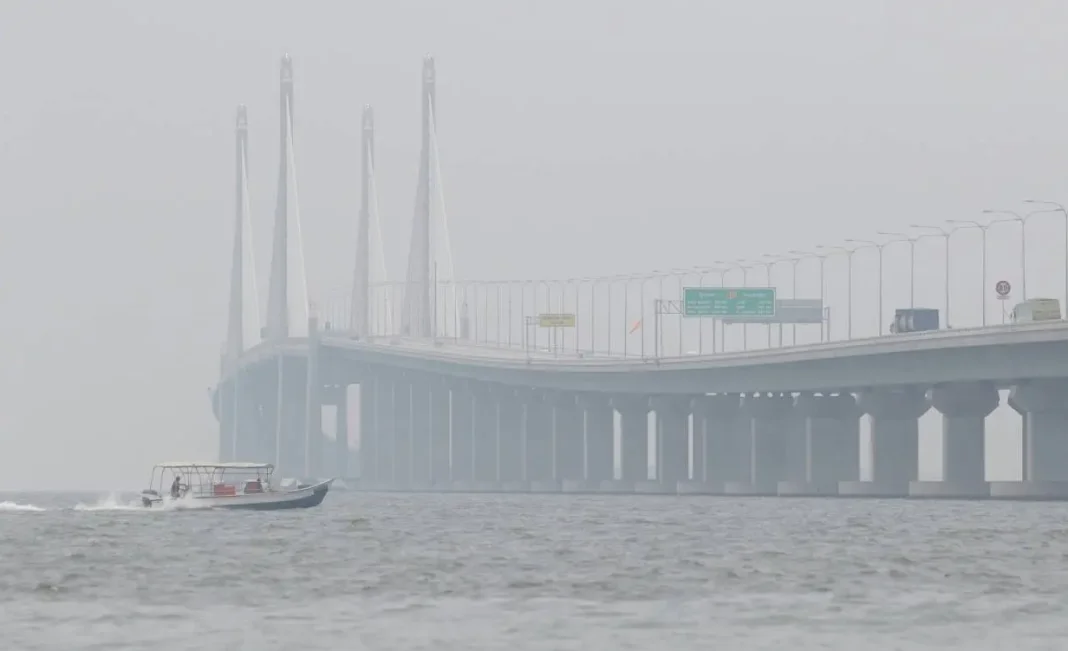
Schools across Penang may be ordered to close and shift to home-based teaching and learning (PdPR) if haze conditions push the Air Pollutant Index (API) to 200 or above, the state Education Department has warned.
Director Mohamad Dziauddin Mat Saad said four monitoring stations in Penang recorded API readings above 160 as of 7am on 16 September, with the department continuing to receive updates every two hours, The Star reported.
As of 9am, Minden recorded an API of 166, Balik Pulau 164, Seberang Jaya 162 and Seberang Perai 160. All four readings fall in the unhealthy range, which spans API 101 to 200.
“At 6pm and 8pm, we will (see if) the readings have reached 200, in line with the guidelines issued. If they do, we will inform schools about the closure… and conduct PdPR,” Dziauddin told reporters after the state-level Malaysia Day celebrations at Dewan Millennium in Kepala Batas.
The department’s decision will depend on readings at individual monitoring stations, with the relevant district education offices informing affected schools. The measures could affect 398 schools and approximately 237,000 pupils, depending on the areas hit.
If the API remains between 100 and 200, outdoor activities at schools will be suspended. “We will temporarily stop activities outside the classroom,” Dziauddin said, adding that the department had yet to receive reports of pupils suffering health problems linked to the haze.
However, schools have been told that if pupils develop respiratory problems or other health issues, parents may take them home early. Pupils could also be allowed to stay home if their absence relates to health concerns from the poor air quality.
The department’s war room, established on 13 August, is helping disseminate information quickly to schools. According to Bernama, the preparedness measures are in line with guidelines from the Ministry of Education, drawn up jointly with the Ministry of Health and the National Disaster Management Agency.
Dziauddin said the department would assess the movement and rate of increase in API readings before deciding, rather than relying on a single reading. “If the 6pm reading shows a sustained increase, we will monitor it until 8pm before making the announcement,” he said.
He advised pupils and the public to take precautions, including wearing face masks and avoiding prolonged exposure to open areas if air quality deteriorates.
API readings between zero and 50 indicate good air quality, 51 to 100 moderate, 101 to 200 unhealthy, 201 to 300 very unhealthy, while readings above 300 are categorised as hazardous.