
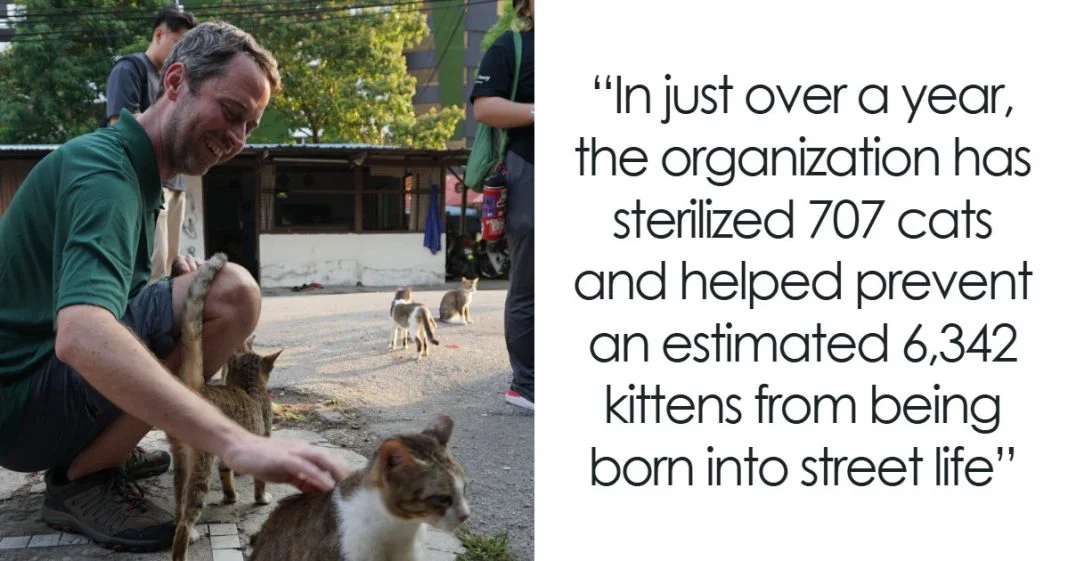
What started as a one-man mission to tackle Penang’s stray cat problem has grown into a volunteer army that has prevented over 7,000 kittens from being born on the streets.
Catsoterra Berhad, formerly known as Cats of Penang, has facilitated the sterilisation of almost 800 cats across the island state since its founding in April 2025. The Trap-Neuter-Return (TNR) programme has subsidised more than RM50,000 in veterinary services and is estimated to have prevented 7,116 kittens from being born into street life, according to Malay Mail.
The organisation operates differently from traditional animal shelters. Instead of rescuing and housing cats, Catsoterra targets the root cause: uncontrolled breeding. Volunteers trap stray cats, bring them to partner clinics for sterilisation, monitor their recovery, and return them to their original territories.
Daniel Lok Chin Leung founded the initiative after witnessing animal welfare systems that failed despite good intentions. The Hong Kong-born founder, now based in Maryland, United States, said running a nonprofit requires the same discipline as running a business.
“After being involved in animal welfare for a long time, I’ve learned that the mission has to remain the driving force behind every decision,” Lok said in an email interview.
“I wanted to be part of building something more sustainable — something that could actually help solve the problem instead of just reacting to it.”
The system runs on a custom-built dashboard. Volunteers pay an annual RM60 membership fee, which gives them access to schedule sterilisation appointments, track their personal impact, and monitor the organisation’s overall progress. Catsoterra covers the base cost of each procedure.
Lok manages the organisation alongside chief marketing officer Johnny “Ricky” Trogdon and IT lead Jonas Breuer, a digital nomad who maintains the platform’s technology. Funding comes primarily from Lok’s personal funds and membership fees, though the team is exploring revenue streams through their dashboard product to reduce reliance on personal funding.
Penang was chosen deliberately. As an island with clear boundaries and an existing TNR foundation laid by other NGOs, it offered the right conditions for targeted work. Lok visits about once a year, most recently spending April 2026 on the ground meeting volunteers and visiting partner clinics.
The organisation now has 77 volunteers across Penang Island and the mainland. They are ordinary residents who set traps, coordinate transport, and care for cats in their neighbourhoods.
“Every statistic represents the efforts of ordinary people choosing to make a difference for animals in their communities,” Lok said.
Catsoterra’s initial target is 1,000 sterilised cats. Once reached, the focus shifts to improving systems, expanding capacity, and increasing impact year after year. The long-term goal is a sustainable model for stray cat population management that other regions could replicate.
The Penang Island City Council has collaborated with other NGOs on TNR programmes for dogs since 2018, proving the concept works at scale. Catsoterra aims to do the same for cats — one volunteer, one cat at a time.
Learn more about Catsoterra at catsoterra.org