
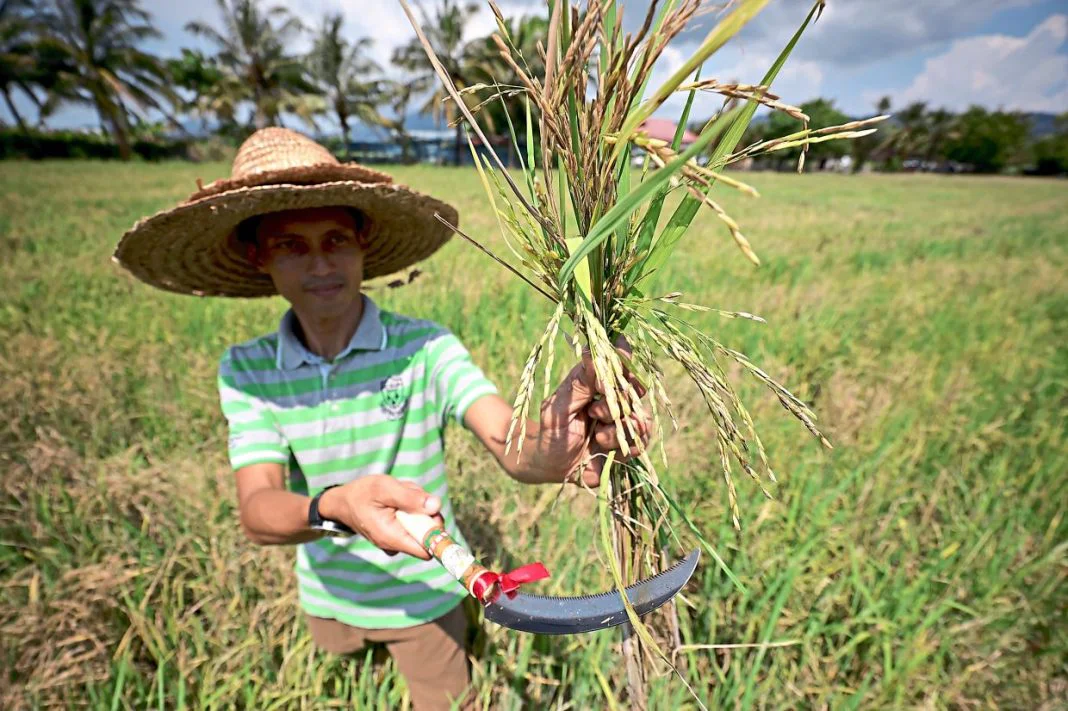
Malaysia is testing a padi method that lets farmers plant once and harvest twice, with a 2ha plot in Jalan Sungai Nipah, Balik Pulau, now into its second harvest after yielding 7.1 tonnes per hectare at the first cut on 19 Aug, The Star reported.
The technique, ratoon padi cultivation, lets new shoots rise from the stubble left after the first harvest, so the land is neither re-prepared nor replanted. The word comes from the Spanish retono, meaning a new shoot, and Chinese farming records describe the practice more than 1,700 years ago.
Penang Chinese Entrepreneurs Association (PCEA) president Dr Lee Eng Wah said the second harvest’s yield had not been fixed yet. The association hopes to take the trial to 20ha next season, he said.
Several technical problems remain. They cover irrigation and drainage, planting schedules, and harvesters heavy enough to crush the stubble that regrowth depends on. “The machinery we are currently using is rather heavy and can damage the first crop during harvesting. This could affect the yield of the subsequent harvest,” Lee said.
The trial covers the land of two farmers and began in May with the MR333 variety, known locally as Menora, after nearly two years of preparation, according to Buletin Mutiara, the Penang government news portal. Other varieties will be tested for local performance, with possible help from the Malaysian Agricultural Research and Development Institute (Mardi).
The work draws on methods from Fujian province in China. State trade and community unity committee chairman Goh Choon Aik visited a 46.7ha demonstration site in Changping village, where one variety was reported to yield 10.7 tonnes per hectare at the first harvest.
Chief Minister Chow Kon Yeow toured the Balik Pulau plot on 31 Oct and said the method works, though the yield is below existing standards. “This is the first time I am seeing it. I can confirm that the method is workable and has produced results, although the yield has yet to meet existing standards,” he said, urging the Agriculture Department and Mardi to judge whether it should be adopted more widely.
He said the state was ready to contribute a light harvesting machine so that cutting does not wreck the stubble, and would carry the approval question to federal level, including the Prime Minister, should obstacles remain. He put the Balik Pulau yields at 20% to 30% below Fujian’s, and said one planting could produce three or four harvests where conditions allow.
The two sites also differ in timing. Fujian’s fields are drier at harvest, while Penang’s hold water through the year-end monsoon. Malaysia’s lack of winter is an advantage, Chow said, because padi can be grown all year if crop management and irrigation are planned well.
Cooperation agreements were signed during the visit, involving Penang Agrotech Sdn Bhd, the PCEA, Fujian Agriculture and Forestry University and a Chinese agricultural technology company.