
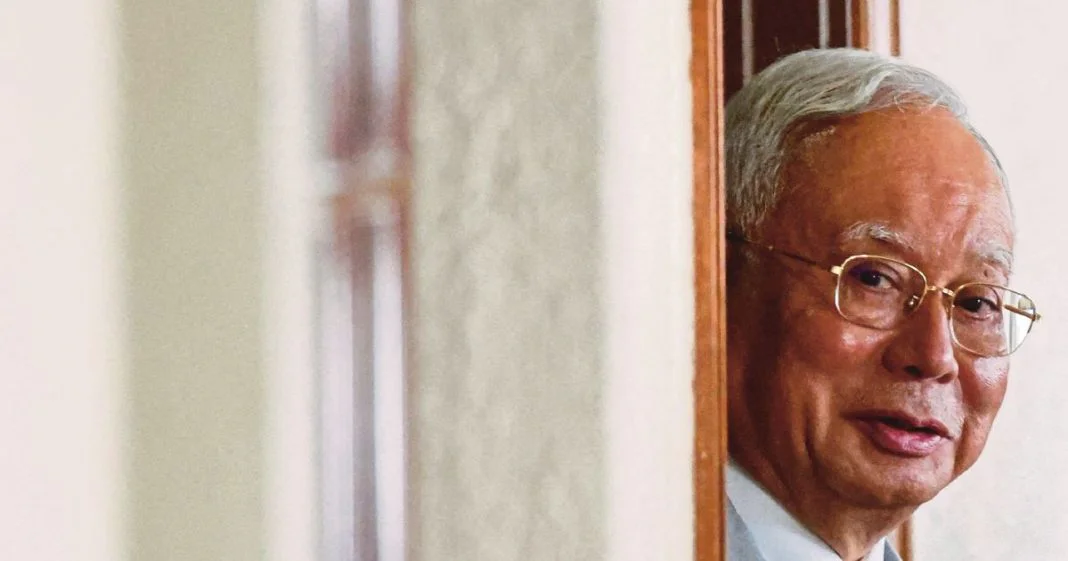
The Federal Territories Pardons Board has granted former Prime Minister Datuk Seri Najib Razak a conditional pardon allowing him to serve the remainder of his prison sentence at home. The decision, announced on 18 September 2026, means Najib could leave prison and serve under house arrest until 23 August 2028, but only after paying a RM50 million fine tied to his SRC International conviction.
The pardon does not make Najib a free man. According to criminal lawyer Datuk S Sivananthan, the arrangement falls under Section 3 of the Prisons Act 1995, which allows the Home Minister to designate any building as a prison through a Gazette notification. His residence could be declared a place of detention, making house arrest a form of imprisonment rather than release, Says.com reported.
Sivananthan told the New Straits Times that prison authorities would determine how the sentence is enforced. This could include stationing officers at his residence, electronic monitoring, and restricting who visits him. The specific conditions have not all been publicly disclosed. If Najib breaches any condition, the pardon can be revoked and he returns to prison.
Najib’s house arrest applies only to his SRC International sentence. He was convicted of seven charges involving abuse of power, criminal breach of trust, and money laundering over RM42 million from SRC International. The Pardons Board reduced his original 12-year prison term to six years and his fine from RM210 million to RM50 million in February 2024.
The arrangement does not cover his separate 1MDB case. In December 2025, the Kuala Lumpur High Court sentenced Najib to 15 years in prison after convicting him of 25 charges of abuse of power and money laundering involving about RM2.3 billion in 1MDB funds. That sentence is set to begin after he completes his SRC International term. Najib has appealed against both his 1MDB conviction and sentence, CNA reported.
Constitutional lawyer Lim Wei Jiet said Najib’s lawyers would need to seek a stay of the 1MDB sentence while the appeal is pending. If granted, Najib would not have to begin serving that sentence until the appeals process is completed. However, if he loses his appeals, the house arrest arrangement would not automatically apply to the 1MDB sentence, and he could be required to return to prison.
Najib’s case is the first time a Pardons Board in Malaysia has allowed a prisoner to serve a sentence under house arrest. Sivananthan said this creates a precedent. “This is going to open the floodgates. People serving sentences for white-collar crimes may ask, ‘Why not me?'” he said. Future applications would still depend on each prisoner’s circumstances and the pardons process.
Analysts said the conditional pardon could lift UMNO’s morale. Political analyst Azmi Hassan told CNA the development could “rejuvenate” UMNO and give the party momentum following its recent electoral successes in Johor and Negeri Sembilan. UMNO president Ahmad Zahid Hamidi said the party has launched a nationwide donation drive to help raise the RM50 million needed for the fine.
The decision also poses a challenge for Prime Minister Anwar Ibrahim, whose administration has emphasised combating corruption. Political researcher James Chin described the development as a “bad look” for Anwar’s government. DAP chief Anthony Loke said the party respects the king’s power of pardon but will continue “defending the rule of law and the fight against corruption.” Lim said house arrest is not yet formally recognised under Malaysian law, with proposed legislation on the matter having been deferred. “So the additional clemency that has now been granted has no corresponding law overseeing it at the moment,” he said.