
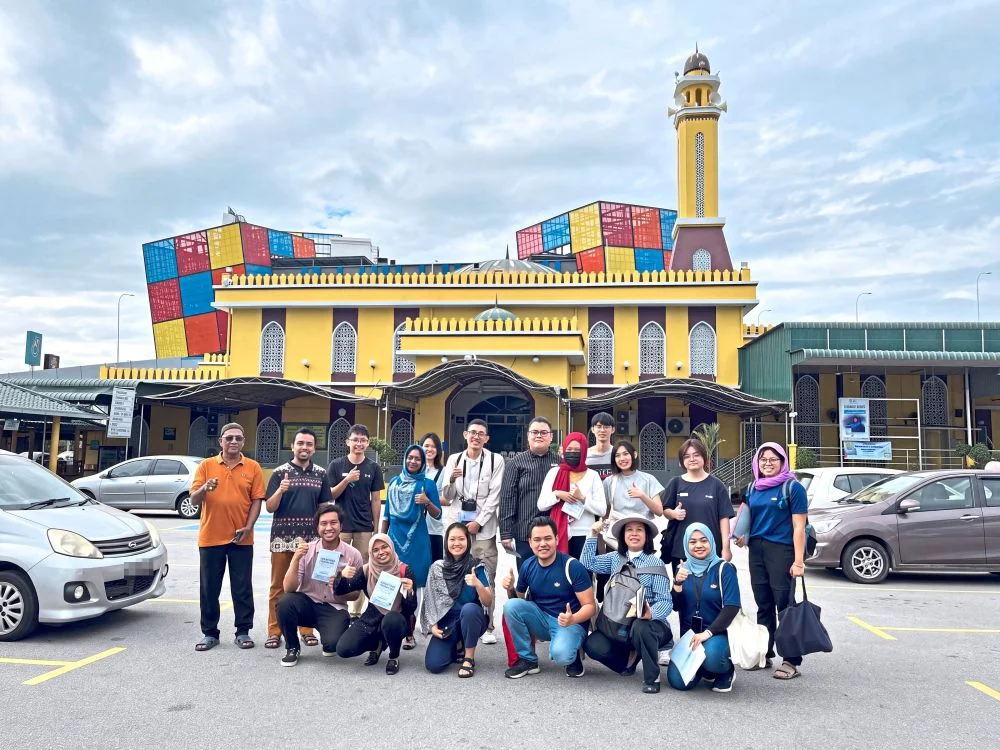
Nine places of worship stand within a kilometre of each other in Seberang Jaya, Penang, forming one of Malaysia’s most striking examples of religious coexistence. The stretch, officially designated as Harmony Street on Malaysia Day in 2022, has drawn renewed attention as Penang moves to replicate the concept in other parts of the state.
Eight of the nine institutions cluster around the intersection of Jalan Todak and Lorong Jelawat 4, while Masjid Sembilang sits just across the Butterworth-Kulim Expressway. The sites include a mosque, Hindu temples, a Buddhist temple, a Taoist temple, a Sikh gurdwara and a Christian church, all within a 300-metre radius, The Star reported.
All nine were either established or relocated to the area around the turn of the century. Masjid Sembilang chairman Muhammad Famizi Hussain said the concentration of religious sites has changed how residents interact. “It creates space for dialogue, where every house of worship can showcase the positive values of its religion,” he told The Star.
Masjid Sembilang was built in Taman Sembilang in 2006, replacing a nearby surau where the local Muslim congregation had previously gathered. Its design combines Moorish elements and Islamic geometric details, attracting visitors from different racial backgrounds, including tourists.
Ku Cheng Tse Temple, established in 1963 before moving to its present building in 2003, blends Thai and Chinese Buddhist architectural elements. Temple chairman David Kong said religion is about spreading good ethics and principles. The Sri Sri Radha Krishna Kanhaiya Temple of Devotion and Understanding, known as Todu, opened in 2015 and features three large ornate domes and 16 pavilions. Its co-chairman Assoc Prof S. Kathiresan said Todu’s inclusion in Harmony Street represented religious diversity and peaceful coexistence.
“Although our traditions may be different, values such as love, compassion, respect, service, humility and peaceful coexistence are universal,” he told The Star.
The remaining sites include Arulmigu Sri Bala Murugan Temple, established in 1968 and relocated to its present site in 2009; Gurdwara Sahib Butterworth, whose roots trace to Sikhs who settled along Jalan Pantai in the early 20th century; Peniel Christian Fellowship, a Pentecostal Christian organisation with more than 100 members; Persatuan Buddhis Seberang Jaya, established in 1985; Guan Yin Temple Seberang Jaya, established in 2003; and Arulmigu Karumariamman Temple, which traces its origins to a wooden shed in a rubber estate more than a century ago.
Penang Harmony Corporation, known as Harmonico, is the state agency tasked with promoting religious harmony among different faith communities. Its general manager Paul Au said the concept has moved beyond tourism through Jelajah Harmoni, a programme that brings secondary school students aged 15 to 18 on guided visits to different houses of worship.
In Seberang Jaya, the programme features two routes covering all nine places of worship, with students spending about half a day learning about different religions and cultures, Au told Bernama. “The programme has been running for about three years and requests from schools are still coming in,” he said.
Penang national unity committee chairman Goh Choon Aik has proposed a similar Harmony Street along Lorong Merak 63 in Simpang Ampat. The area is home to Chinese temples, a surau, community halls and a hawker centre. Goh, who is assemblyman for Bukit Tambun, said the proposal could strengthen the Malaysia Madani concept by encouraging respect for differences.
“This is not simply a collection of facilities, but a living example of how Malaysians of different backgrounds can share the same neighbourhood, use the same community spaces and build relationships with one another,” he told The Star.
Currently, four Streets of Harmony operate across Penang, in George Town, Seberang Jaya, Bukit Mertajam and Bayan Baru. Harmonico plans to expand the initiative to Sungai Pinang, Pulau Tikus, Batu Feringghi, Teluk Bahang and Bukit Tambun, with the goal of establishing Penang as Malaysia’s “City of Harmony.”