
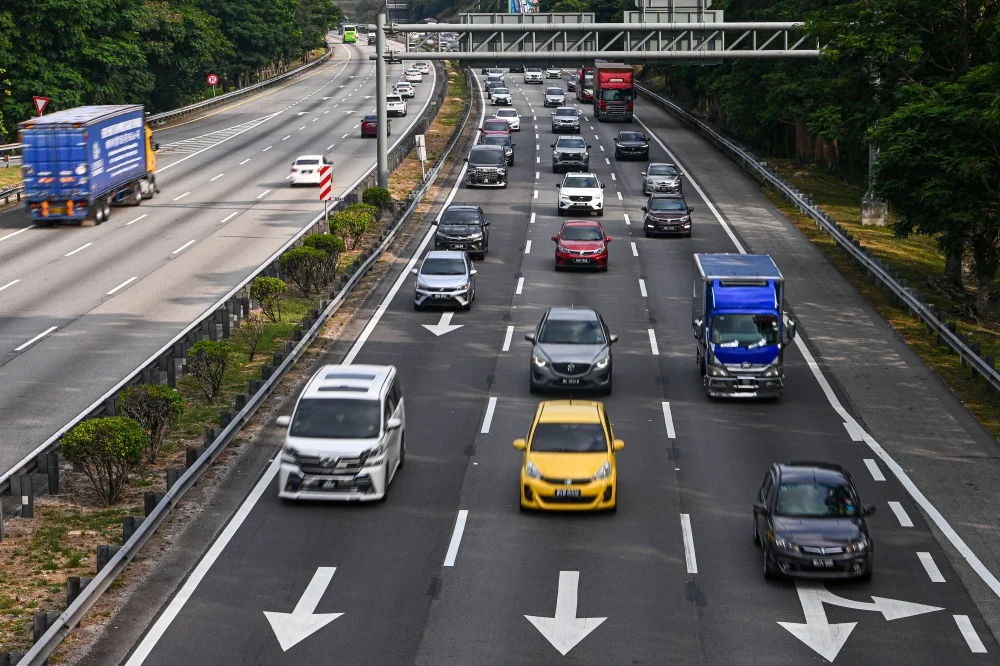
Malaysia is testing advisory minimum speed limits on three highway stretches to cut lane hogging and the “phantom jams” it creates behind slow-moving vehicles in fast lanes.
The Malaysian Institute of Road Safety Research (MIROS) launched a three-month proof-of-concept trial on 1 August, setting recommended minimum speeds for each lane based on total lane count. On three- and four-lane highways, the rightmost overtaking lane carries an advisory minimum of 100 km/h. Middle lanes are set at 80 km/h or 60 km/h, and the left cruising lane at 60 km/h, Malay Mail reported. On two-lane expressways, the right lane minimum drops to 80 km/h.
The trial runs at three pilot locations: the northbound PLUS E1 stretch between Tanjung Malim and Behrang, the SKVE E26 link from Ayer Hitam toll plaza to Bandar Saujana Putra, and the northbound PLUS E2 route connecting Bandar Ainsdale to Nilai, Paul Tan’s Automotive News reported. Overhead signboards will display the guidance throughout each pilot stretch until 31 October, after which MIROS will assess the data before deciding on a nationwide expansion.
Crucially, the figures are advisory, not enforceable. Existing maximum speed limits and vehicle-specific restrictions remain fully in force, and motorists should still adjust their speed during heavy rain, poor visibility, or congestion.
The approach draws on well-established research showing that highway danger comes not from speed alone but from speed variance. A car cruising at 70 km/h in the right lane of a 110 km/h highway forces every vehicle behind it to brake, change lanes into the blind spot-riddled space the hog creates, accelerate past, and merge back. Each of those manoeuvres is a collision opportunity, and the lane hog is oblivious to the risk it generates.
There is a traffic-flow cost too. When a following driver brakes behind a slow vehicle, that braking wave propagates backwards through dense traffic. A 2008 Japanese experiment famously demonstrated that drivers asked to maintain constant speed around a circular track spontaneously produced stop-and-go shockwaves. One slow vehicle in the overtaking lane can congest a highway for kilometres behind it.
Lane hogging is already an offence in Malaysia, carrying fines of up to RM2,000. The middle and right lanes are legally reserved for overtaking, with the left lane the default cruising lane. Heavy vehicles are separately banned from the right lane on highways. What the MIROS trial adds is the other side of the equation: not just “do not camp in the fast lane,” but “if you are in it, keep up.”
Drivers on the trial stretches are encouraged to pick the lane matching the advisory speed on the signboards, avoid overtaking from the left, give way to vehicles wishing to overtake, and maintain a safe following distance.
Similar minimum speed measures exist in other countries. Germany’s Autobahn sections typically impose minimums around 60 km/h to keep slow vehicles out of faster traffic. Japan’s expressways enforce a 50 km/h minimum, and several US states apply minimum speed limits in selected areas to prevent vehicles from becoming hazards.
If the proof-of-concept delivers results, advisory minimum speed signage could spread to more Malaysian highways. In the meantime, the trial signals a shift in how MIROS frames highway safety: lane discipline is not courtesy, it is capacity.