
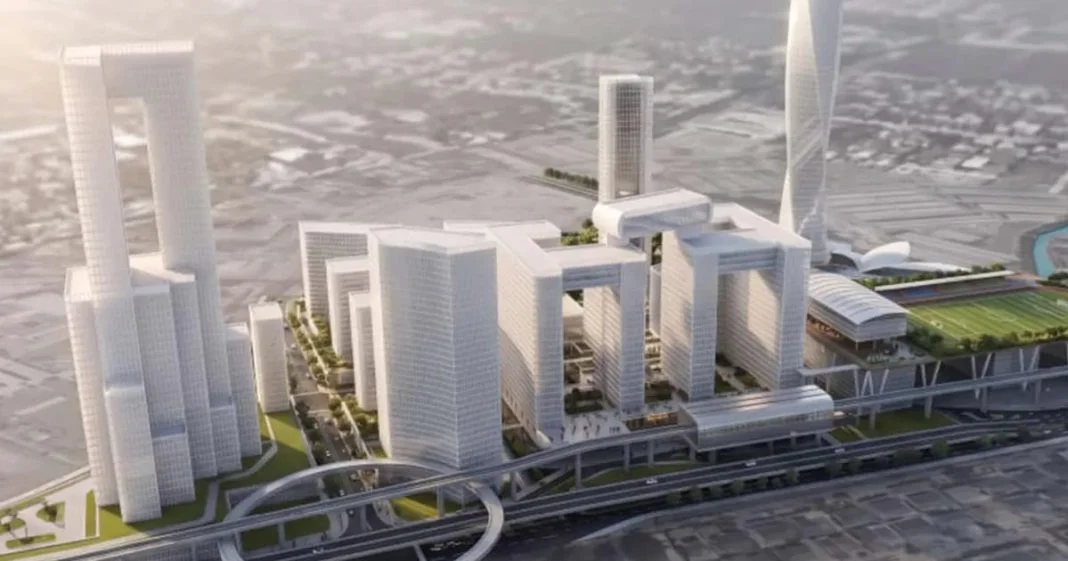
The Penang government today unveiled the draft master plan for the proposed Sg Nibong Transit-Oriented Development (TOD) at the now-closed Tapak Pesta Pulau Pinang.
State infrastructure, transport and digital committee chairman Zairil Khir Johari said the Sungai Nibong master plan marked “the beginning of a new chapter” in Penang’s urban planning direction, Free Malaysia Today reported.
The draft master plan was prepared with the Asian Development Bank (ADB), appointed consultants, MRT Corporation, and various federal and state agencies. It is expected to be finalised by October, said Malay Mail.
Penang Chief Minister Chow Kon Yeow said the execution phase would be the challenging part and was projected to take between 10 and 15 years.
“This master plan represents a model for how future urban centres across Penang may eventually evolve around high-capacity public transport,” NST quoted Zairil as saying.
The proposed TOD covers about 23.4 hectares at the former Pesta site, which will host commercial buildings, a hospital, a hotel, a bus terminal, a sports complex, a cultural centre, a green park, and a building for the Penang Island City Council (MBPP). A retention pond and a stream will be built to manage flooding, as Sungai Nibong is vulnerable to flash floods. A network of walkways will make the area pedestrian-friendly.
Chow said various financing methods would be considered, with some projects fully public or privately financed, and others funded through public-private partnerships (PPP). The execution model would be determined based on suitability for each component.
He said the execution phase would include determining the project management structure, financing arrangements, and the respective roles of the public and private sectors. MRT Corp’s responsibility would be limited to constructing the LRT depot and station at Sungai Nibong, while the remaining components would be undertaken by the state government as the land belonged to the state.
Zairil said limiting car dependency through efficient public transport, pedestrian-friendly design, and parking controls would be key to the TOD’s success.
“The whole idea (of a TOD) is to discourage people from using their cars by designing a system that’s very conducive and pedestrian-friendly, enabling you to get everything you want within a certain convenient radius,” he said.
He acknowledged concerns about worsening congestion along the nearby Jalan Sultan Azlan Shah, given the high-density development proposed for the TOD area. He said parking requirements for commercial and residential developments would also be reduced.
Sungai Nibong was selected because of its strategic location as a future multimodal transport hub, linking the Mutiara LRT Line with existing interstate and local bus services, while being close to the Penang International Airport, the Bayan Lepas Free Industrial Zone, and surrounding residential communities.
The entire development area covers about 23.47 hectares (58 acres), including the LRT depot. The Penang Pesta component under the new master plan would be considerably smaller, as much of the site had been allocated for the LRT depot, LRT station, bus terminal and public park. However, the identity of Penang Pesta would be preserved in a new form through the development of a cultural centre, commercial spaces and entertainment areas that could operate throughout the year, instead of being limited to the traditional year-end fair.
During a presentation on the draft TOD, ADB architect and urban planner Pranjali Deshpande and Abhijit Kondalkar revealed that the proposed project included up to 700 units of affordable housing and 350 units of high-end housing, with a residential population of about 3,600 people. They also said limited parking spaces would be available at the Pesta site to encourage the use of public transportation.
Zairil said Sungai Nibong was already an established transport hub with intercity and local bus services. The upcoming Mutiara LRT line, with 21 stations, would turn it into a fully integrated multimodal interchange.
When asked about the project’s gross development value (GDV), Chow said the estimate had yet to be announced as the master plan remained in its final preparation stage, with the final report expected to be completed in October.
On a separate matter, Chow said the state financial department was in talks with the Penang Regional Development Authority (Perda) to temporarily move the Pesta Pulau Pinang fair to Perda-owned land in Kubang Menerong, Kepala Batas.