
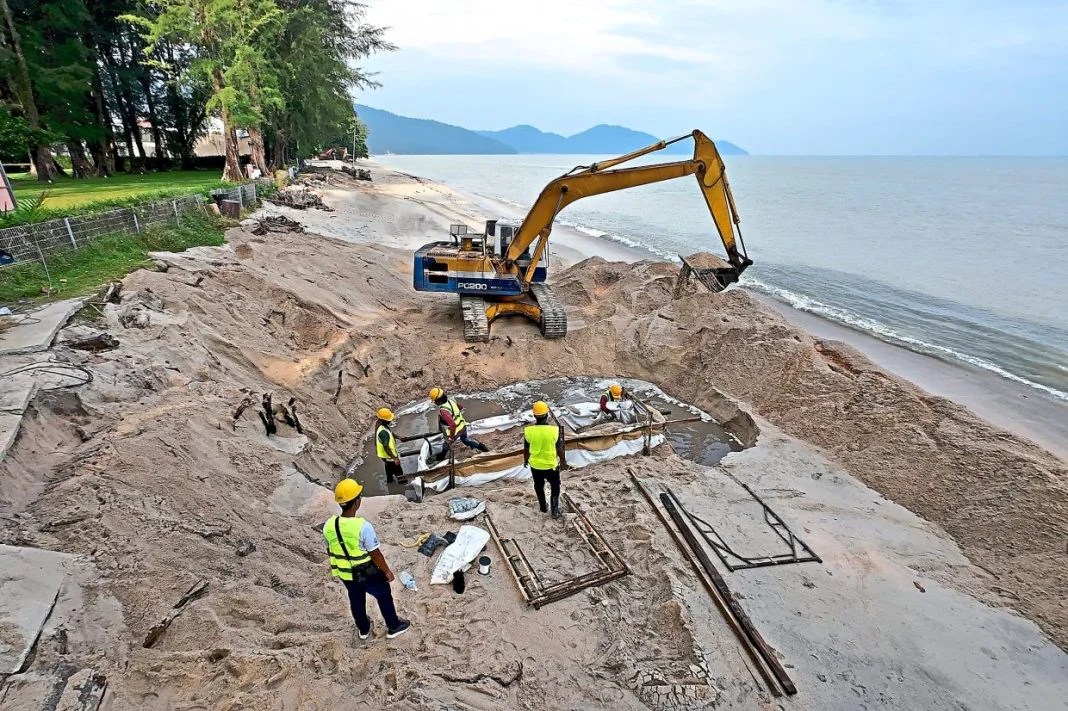
Workers are burying giant sandbags into a trench along Batu Ferringhi beach as Penang races to hold back coastal erosion threatening one of its most recognisable tourist strips.
The RM500,000 mitigation project, led by the state Department of Irrigation and Drainage (DID), started on 8 JULY in front of the Lone Pine Hotel. Sixty-two beach containers will be installed along a 44-metre stretch of shoreline, with completion expected by 10 AUGUST, according to The Star.
State infrastructure committee chairman Zairil Khir Johari said the containers are designed to reduce wave impact and slow the rate of erosion while a comprehensive coastal protection project moves through the planning stage.
“Based on DID’s technical assessment, this mitigation measure is expected to remain effective for two to three years, depending on weather conditions, wave activity and natural factors such as tidal changes and extreme weather events,” he said.
The project caps more than a year of escalating intervention at Batu Ferringhi. In APRIL 2025, the federal government approved RM250,000 for sandbag placement after Bernama surveys showed erosion worsening near prominent hotels, with breakwater sandbags already scattered along the shoreline, Malay Mail reported. By FEBRUARY 2026, wave heights had risen roughly 0.6m above normal, rendering those barriers ineffective and prompting DID to raise their height.
Zairil warned that delaying the current works could allow erosion to extend further inland, putting permanent structures, public amenities and infrastructure near the shoreline at risk.
On the long-term front, a coastal protection project approved under the 12th Malaysia Plan is in the consultant appointment phase, The Star reported. The scheme, estimated at RM60mil, covers a three-kilometre stretch from Tanjung Bungah to Batu Ferringhi and will include coastal defence structures and beach nourishment works.
Contractors face a narrow working window each day, as the containers can only be installed during low tide. Continuous rain, strong winds, high waves and the absence of direct access routes for heavy machinery have added to the complexity, Zairil said.