
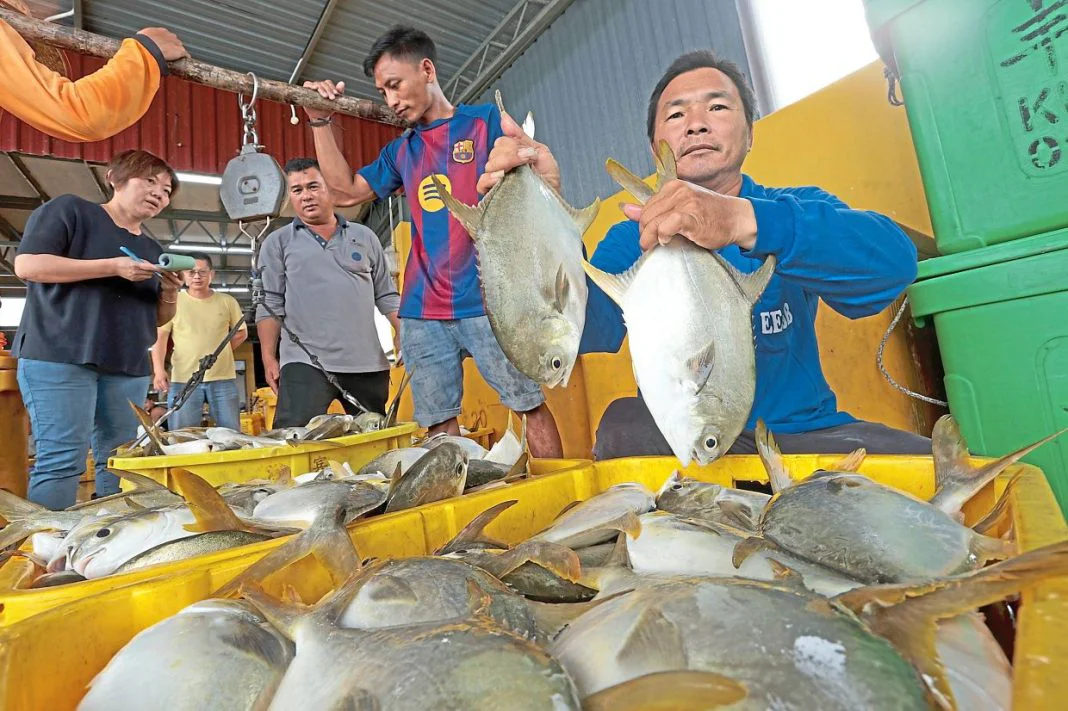
Hundreds of tonnes of farmed marine fish produced each month in Penang face an uncertain future. According to The Star, the Sungai Udang floating fish farming zone is set to be reduced to make way for a planned maritime access route to Batu Kawan.
About 25 operators are now racing to secure new offshore sites before their temporary occupation licences expire at the end of the year. The sprawling network of floating fish cages, visible to motorists crossing the second Penang bridge towards the island, produces about 20,000 tonnes of farmed saltwater fish annually for markets nationwide.
Sungai Udang Fish Farm Association chairman Tioh Tiang Lai said the operators were willing to relocate, but only if a suitable replacement site could be found.
“If our TOLs expire at the end of the year, we will technically be operating illegally and will no longer qualify for government subsidies or other official assistance,” he said.
His association members relocated to the current site about four years ago, drawn by deeper and cleaner waters at about 8m deep. Tioh said the conditions remain ideal and should sustain fish farming for another 15 to 20 years.
“The stronger currents improve water circulation and oxygen levels while carrying away uneaten feed and fish waste. The fish are healthier and the seabed has time to recover,” he said.
He identified waters near Pulau Gedung, off Pulau Aman, as an ideal relocation site, but fishermen from Pulau Aman have objected to the proposal. About 80 fish farms in the zone produce roughly 30 tonnes of marine fish daily, including pomfret, snapper, trevally and grunter.
Penang Fish Farmers Association chairman Khor Gin Tiam said the industry must identify new offshore farming areas to support future expansion.
“We produce not only for Penang but also supply other states, with some of our fish exported to neighbouring countries,” he said.
Khor said traditional farming areas in Sungai Udang and Kuala Kurau had reached capacity, while relocating fish farms was becoming increasingly difficult.
“If we cannot expand into new offshore areas, the existing farming sites may not be able to sustain the industry for another 10 years,” he said.
“Suitable offshore sites are limited because fishermen object to proposed locations, while relocating floating cage systems secured by 20 to 40 seabed anchor ropes is also costly.”
Penang Fisheries Department director Azimah Jumatli said the state had proposed new offshore sites beyond three nautical miles from the coastline, between the Penang and Perak maritime boundary.
“The proposed sites will require joint verification by the National Hydrographic Centre and the Malaysian Marine Department to ensure there are no conflicting maritime activities,” she said.
Figures from the Fisheries Department for 2024 show Penang remains Malaysia’s largest producer of marine aquaculture despite its limited sea farming areas. The state recorded 54,767 metric tonnes of production worth RM1.14bil, compared with 36,478 tonnes worth RM830.74mil in Perak and 4,295 tonnes valued at RM165.01mil in Selangor.
“These figures show Penang continues to be the country’s leading producer of marine cage aquaculture despite constraints on available sea farming areas,” Azimah said.