
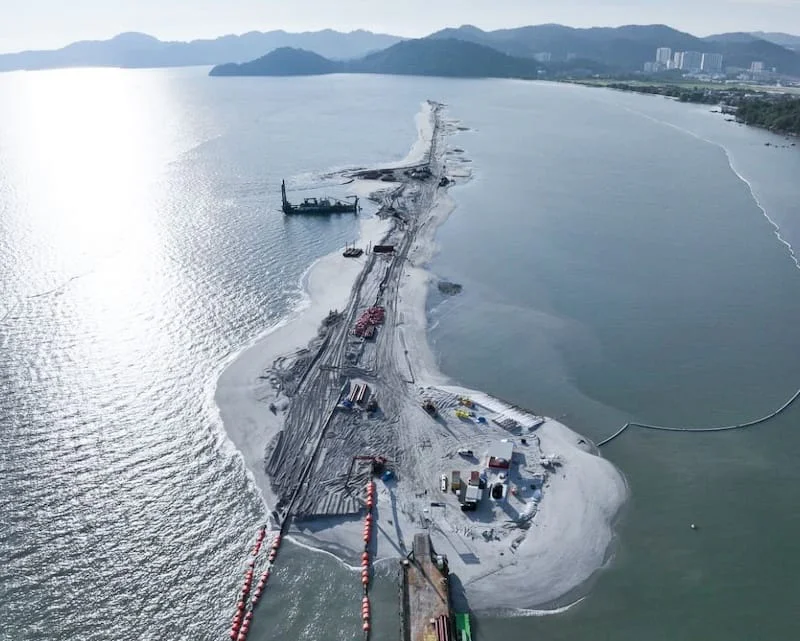
The Court of Appeal’s dismissal of an appeal against the Penang South Reclamation project has left both sides claiming victory and exposed a jurisdictional gap that could shape every future coastal development in Malaysia.
The three-member bench dismissed the appeal on 30 June on procedural grounds, ruling that seven fishermen and two environmental groups filed their challenge 28 days too late. But in its written grounds, the court also addressed a question no Malaysian court had answered before: whether state planning authorities have the power to approve land reclamation in territorial waters.
The court said they do not.
“We are of the view that the first and/or second respondents had no power to issue the planning permission (for the reclamation),” Justice Wong Kian Kheong wrote. The first and second respondents were the director of the Penang town and country planning department and the state planning committee, which granted planning permission on 21 August 2023.
The finding rests on the Territorial Sea Act 2012, which vests sovereignty over the territorial sea, its seabed and subsoil, in the Yang di-Pertuan Agong. The court held that the reclamation site, off Penang’s southern coast, remained territorial sea and therefore under federal jurisdiction until the reclamation was completed.
Both sides read the ruling differently.
Chief Minister Chow Kon Yeow said the project would proceed. “As far as the state is concerned, the project will proceed because there is no injunction or any order stopping it,” he told reporters in Balik Pulau on 4 July.
Sahabat Alam Malaysia (SAM), one of the appellants, said the finding meant the planning permission was granted without lawful authority. “The project therefore should not proceed, and we urge the federal government to step in urgently,” SAM honorary secretary S. Mageswari Sangaralingam said.
The state government offered a third interpretation. State executive councillor Zairil Khir Johari said the planning permission issued in 2023 was not what authorised the reclamation. Since the site was still territorial sea and not yet land under a local planning authority, he argued, separate planning permission for the reclamation itself was not required.
But legal experts said the ruling left the central question unresolved.
Jason Chuah of the Maritime Institute of Malaysia said the court’s position was that even if there was no power to issue planning approval, the approval was not set aside because the appeal was filed out of time. He said the ruling mattered because anyone challenging a future reclamation project could now cite it.
Ismail Isa, an urban planning lecturer at Universiti Sains Malaysia, said planning permission was usually for development on land, but before reclamation was completed, the site was still a seabed under federal control.
Senior lawyer Gurdial Singh Nijar said the ruling was correct because it addressed jurisdiction. “Who has the right, and within what powers can they act? They can only act within their powers,” he said.
The bench comprised Federal Court judge Datuk Azimah Omar and Court of Appeal judges Datuk Wong Kian Kheong and Datuk Ismail Brahim.
The Penang South Reclamation project, also known as Silicon Island, was originally proposed as a 1,821-hectare development involving three artificial islands off southern Penang. It was scaled down in 2023 to 930 hectares, with only Island A to be built. Islands B and C were shelved. The project is the state government’s flagship development, intended to finance the Penang Transport Master Plan.
The appeal was filed by seven fishermen led by Zakaria Ismail, along with SAM and Jaringan Ekologi dan Iklim. They challenged planning permission granted on 21 August 2023 by the Penang town and country planning department director, arguing the process breached the Town and Country Planning Act 1976 and the Environmental Quality Act 1974.
The High Court dismissed the challenge in July 2024, ruling the application was filed out of time and that the planning permission was lawfully issued. The Court of Appeal also dismissed the appeal on the time-bar, but reached the opposite conclusion on the substantive issue.
The court made no order as to costs, saying the appeal raised matters of public importance.