
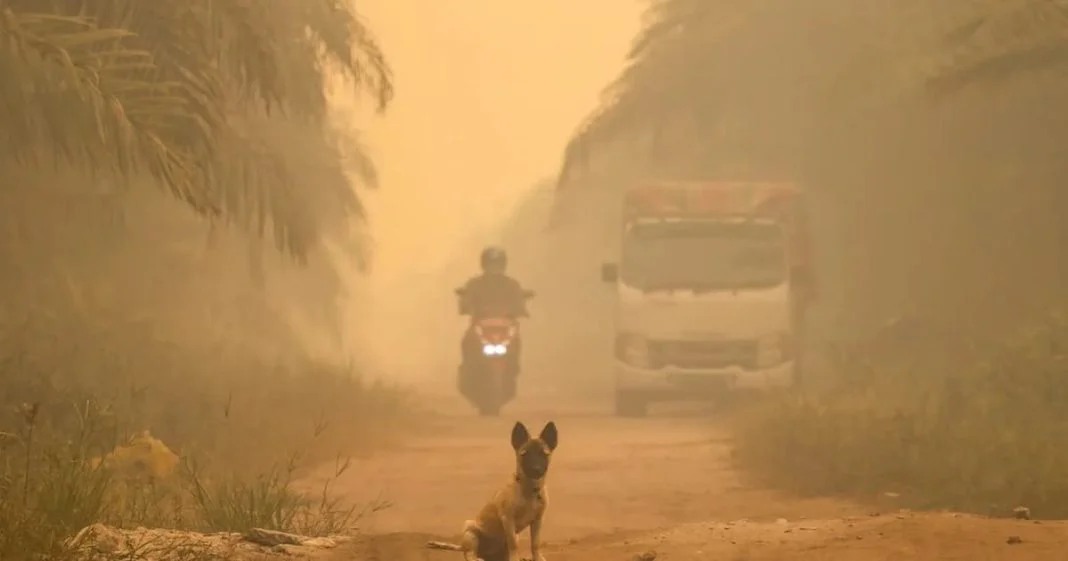
Indonesia and Malaysia have entered formal discussions to combat transboundary haze, with weather modification operations along their shared border among the first measures under negotiation. The talks come as forest and land fires in Kalimantan drive air quality in neighbouring countries to dangerous levels.
A spokesman for Indonesia’s national disaster agency said bilateral talks have produced an agreement to strengthen cooperation across prevention, monitoring and weather modification. “We have agreed to strengthen cooperation, including in prevention, monitoring and support for weather modification operations,” he told FMT. Malaysia has also conveyed its readiness to assist in firefighting, though Jakarta has yet to make a formal request for assets such as water-bombing aircraft.
Unhealthy air quality was recorded in Serian, Sarawak, with air pollutant index readings reaching 195, just below the 201 threshold for very unhealthy classification. Smoke from fires in hard-hit West Kalimantan is the primary driver. The haze has also affected Kuala Lumpur, Selangor, Penang, Kedah and Perak, all registering unhealthy API readings. CNA reported that by 26 August, 16 areas across Malaysia remained in the unhealthy range, with Sri Aman in Sarawak posting an API of 166.
The Singapore-based ASEAN Specialised Meteorological Centre detected 287 hotspots in Kalimantan and 65 in Sumatra on 25 August, with another 11 in Malaysia. The scale of the fires has prompted both governments to escalate their response ahead of national holidays.
Natural Resources and Environmental Sustainability Minister Arthur Joseph Kurup said the commitment was reached during a phone call with Indonesian Environment Minister Jumhur Hidayat on 24 August. “With the El Nino phenomenon expected to intensify towards October 2026, coinciding with the Southwest Monsoon, both nations are fully committed to stepping up prevention and early suppression measures,” Arthur said in a statement, as quoted by CNA. He added that Indonesia had granted official clearance for Malaysia to cross its airspace for cloud-seeding operations along the border.
Arthur also noted Indonesia’s deployment of an additional 1,500 Indonesian National Armed Forces personnel, high-capacity helicopters for water-bombing missions, and weather modification operations on the ground. Malaysia’s National Disaster Management Agency and MetMalaysia are preparing a timetable to synchronise operations with the Indonesian Armed Forces Commander.
Indonesia’s measures have drawn scrutiny from neighbouring nations, with The Jakarta Post reporting that questions remain over operational details. TNI spokesperson Muhammad Nas said authority over cloud-seeding operations falls under Indonesia’s Transportation Ministry, adding uncertainty to the logistics of cross-border coordination.
The Malaysian consulate in Pontianak said the haze in Kalimantan was the worst since 2024, with its focus on the health of 577 registered Malaysians in West Kalimantan. Malaysia previously supported firefighting efforts in the province, with the consulate contributing six water pumps to the governor’s office in 2023.
Under Malaysia’s National Haze Action Plan, all outdoor activities are suspended when API readings exceed 100, and schools, kindergartens and nurseries close immediately when readings surpass 200. The Department of Environment cited the movement of haze from various directions for the increase in affected areas along the west coast of Peninsular Malaysia and in Sarawak. Malaysia Health Minister Dzulkefly Ahmad said the ministry had recorded a surge in asthma and upper respiratory tract infection cases linked to the haze.
Experts have warned the worst may be ahead, with the intensifying El Nino and southwest monsoon increasing the risk of severe fires into October. Rains that could extinguish the blazes look unlikely before November.