
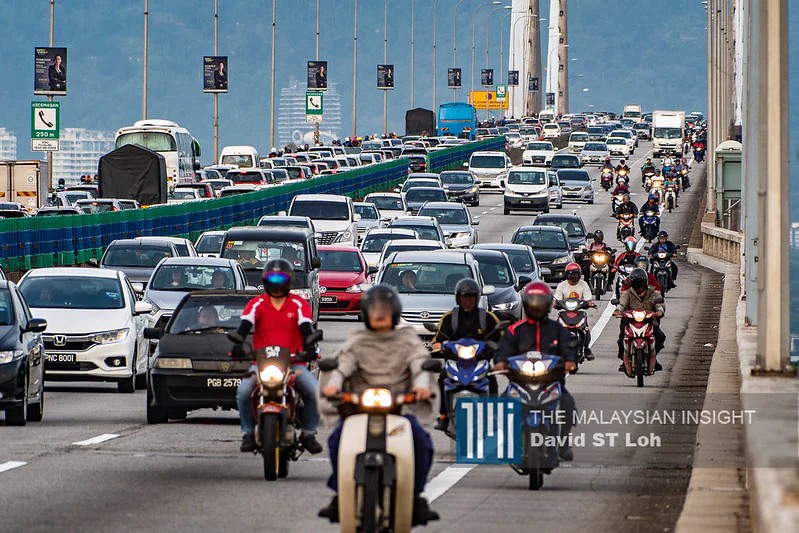
Penang had 1.8 million residents in 2024 but 2.67 million registered vehicles, comprising 1.52 million motorcycles and 1.15 million cars, as of October that year. That ratio, nearly two vehicles per resident, was cited during the 2026 Budget debate in the state assembly. Now, a transport expert has warned the state is heading for gridlock.
Professor Datuk Dr Ahmad Farhan Mohd Sadullah said congestion was increasingly evident on the island and mainland, particularly around both bridges, Batu Kawan and the northern approach to the island, during peak hours. Queues at the Jawi toll plaza from Nibong Tebal have also grown over the years, NST reported.
Farhan said Penang lacked sufficient data to measure congestion and develop evidence-based solutions. Technology exists to monitor traffic, but authorities need better origin-and-destination data to determine where trips begin and end, how developments affect traffic flow and how travel patterns have changed. The gig economy and heavier vehicle profiles have added further complexity. Without better data, planners risked addressing symptoms rather than causes.
Worsening congestion was partly linked to rapid land-use development, including projects on reclaimed land. Farhan cited Lebuhraya Tun Dr Lim Chong Eu, where projects on reclaimed land had created multiple access points onto an already heavily used trunk road. “One project may appear manageable in isolation, but several projects feeding the same road can produce a fundamentally different outcome,” he told NST.
The statistics paint a stark picture. Penang’s 2.67 million registered vehicles far outnumber its 1.8 million residents, a ratio raised during the state assembly’s 2026 Budget debate. Private vehicle ownership in the state is among the nation’s highest, with 95 per cent of households owning at least one car, The Vibes reported, citing state executive councillor Zairil Khir Johari.
Zairil, who oversees traffic management and infrastructure, acknowledged that Penang’s road network was underdeveloped and easily overwhelmed. The state has subsidised charter bus routes and the Mutiara monthly pass, and monthly Rapid Penang commuters ride for free. MBPP also hiked public parking charges by 40 per cent, imposed time limits on parking lots along the Chulia Street and Little India tourism belt, and placed five main town roads under constant monitoring for double parking.
Penang is also studying congestion charges during peak hours. Travel time between Penang International Airport in Bayan Lepas and George Town, once 30 minutes, now reaches 90 minutes during peak periods or after road mishaps, The Vibes reported.
MBPP enforcement data underlines the scale. The council issued 137,794 parking compounds in the first quarter of 2025, with 1,771 vehicles towed and 2,544 clamped. In 2024, 435,258 compounds were issued with 9,063 vehicles clamped and 5,786 towed. Last year, that rose to 483,308 compounds with 8,977 clamped and 6,791 towed.
Farhan called for a three-pronged approach involving engineering, education and enforcement. Engineering measures should improve road hierarchy, optimise traffic lights and remove bottlenecks. Education should encourage better road-user behaviour, while enforcement should ensure compliance. He also said stricter parking policies and eventual congestion pricing were needed, even if unpopular.
“Such policies will be unpopular but at those times when we need effective solutions, unpopular decisions are needed,” he told NST. Farhan warned that without decisive action, major hotspots might reach a point where roads reached crush capacity and vehicles could no longer move or disperse effectively.