
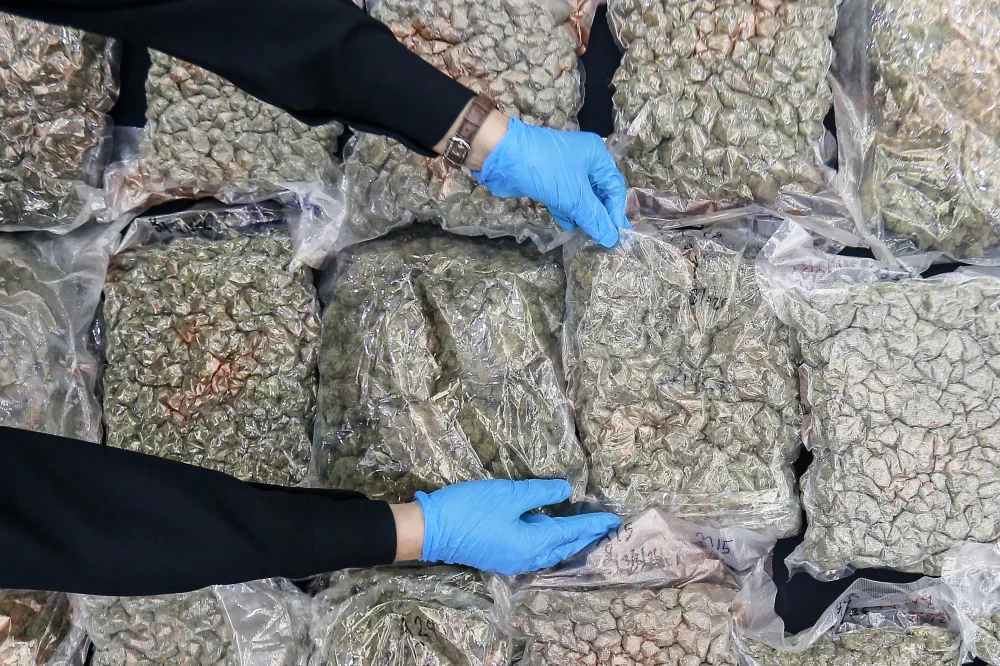
Federal narcotics police seized 270kg of ganja worth RM21.62 million in a month-long operation that dismantled an international syndicate storing drugs near Malaysia’s airports before shipping them to Europe.
Malay Mail reported that the nine suspects, aged between 22 and 51, were arrested in three separate raids between 12 July and 3 August. The operation targeted a distribution network using terrace houses near Penang International Airport in Bayan Lepas and Kuala Lumpur International Airport near Nilai, Negeri Sembilan, as temporary storage before handing drugs to recruited mules.
The crackdown came as tighter security at KLIA pushed syndicates to exploit alternative routes through Penang. “When KLIA becomes ‘hot’, they may use other airports. These syndicates are always looking for opportunities and will exploit every avenue available, whether by land, sea or air,” Bukit Aman Narcotics Crime Investigation Department director Datuk Hussein Omar Khan told a press conference at the Selangor police headquarters.
According to Newswav, investigations found the syndicate had been active since April. It sourced cannabis buds from a neighbouring country, bringing them into Malaysia through the northern borders of Peninsular Malaysia before storing the drugs at houses near airports. The operation, dubbed Op Lejogaster, led to the arrest of nine suspects, comprising five Portuguese nationals, two Singaporeans, a Malaysian and a Burmese national.
The first raid on 12 July, carried out in front of a hotel lobby in Bayan Lepas, led to the arrest of three suspects and the seizure of 290 packages of ganja flowers from residences and luggage in Penang and Mantin, Negeri Sembilan. Police arrested six more suspects around Sepang, Selangor, and Bayan Lepas on 3 August, seizing an additional 60 packages.
“The overall drug seizure weighed 270.27kg, with an estimated value of RM21.62 million, enough to supply some 630,000 users,” Hussein said. Police also rescued four foreign nationals believed to be at risk of being exploited as drug mules.
Hussein identified the mastermind as a Portuguese man coordinating the syndicate’s activities from Europe, including recruiting individuals to travel to Malaysia as drug mules. “Most of their routes were through Bayan Lepas and KLIA, with some travelling directly while others transited in Singapore. Most routes were to London, where another syndicate would receive them,” he said.
The case is being investigated under Section 39B of the Dangerous Drugs Act 1952, which carries the death penalty or life imprisonment and whipping of not less than 12 strokes upon conviction.