
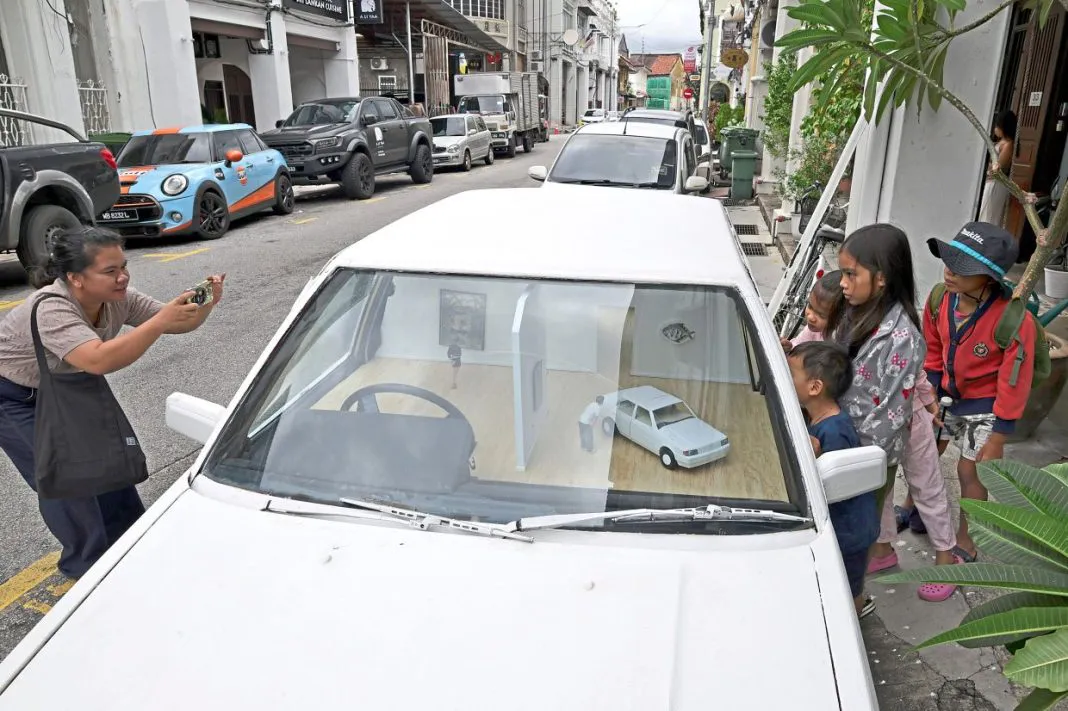
An old chalk-white car parked along Lebuh Melayu is now a miniature art gallery, and the Penang Island City Council has allowed it to stay in the same parking lot until 31 Dec. The installation sits outside the Cultprint gallery at 35, Lebuh Melayu, and it is free to view at any hour, The Star reported on 15 Nov.
Inside the car is a complete exhibition: paintings, sculptures, wooden flooring, white exhibition walls and tiny visitors studying the work. A woman in black with red high heels stands before a painting while a second figure leans in to examine a miniature replica of the car itself.
A small black cat sits beside a scaled-down copy of “Little Children on a Bicycle”, the Armenian Street mural that made the Lithuanian-born artist Ernest Zacharevic famous after the George Town Festival in 2012. Works by street artists Alex Face and Kenji Chai hang on the gallery walls, including Chai’s turquoise dog graffiti known as Chaigo, and the driver’s area has been given over to pieces by Teebai. Tiny benches, arranged lighting and a miniature fire extinguisher complete the effect.
The car occupies a public parking bay in the heritage core, a short walk from Armenian Street, where the murals he painted that year have since become landmarks. Everything on show is seen from the street, with the windows doing the work of a gallery doorway.
Called Cultprint Drive-By, the installation is the brainchild of Zacharevic. The gallery said in a statement that the project “reimagines how contemporary art can be brought directly into the public sphere”.
Zacharevic told The Vibes in March that he wanted more abandoned vehicles reused this way. “I hope more abandoned vehicles can be reused as platforms for artworks,” he said. “I hope to line up several of them as an exhibition space soon.”
The pieces came out of a collaboration between Zacharevic and a group of street artists, and the gallery he opened on Malay Street runs exhibitions, collaborations and community events. Cultprint hopes the car can move to different locations across George Town every few months, and described the work as a chance for Penang to expand its legacy of public art through a new format. The council approved its application for the display to remain where it is until the end of the year.
For now, the viewing happens from the pavement. Passers-by stop at the parking lot and peer through the glass at a gallery that never closes.