
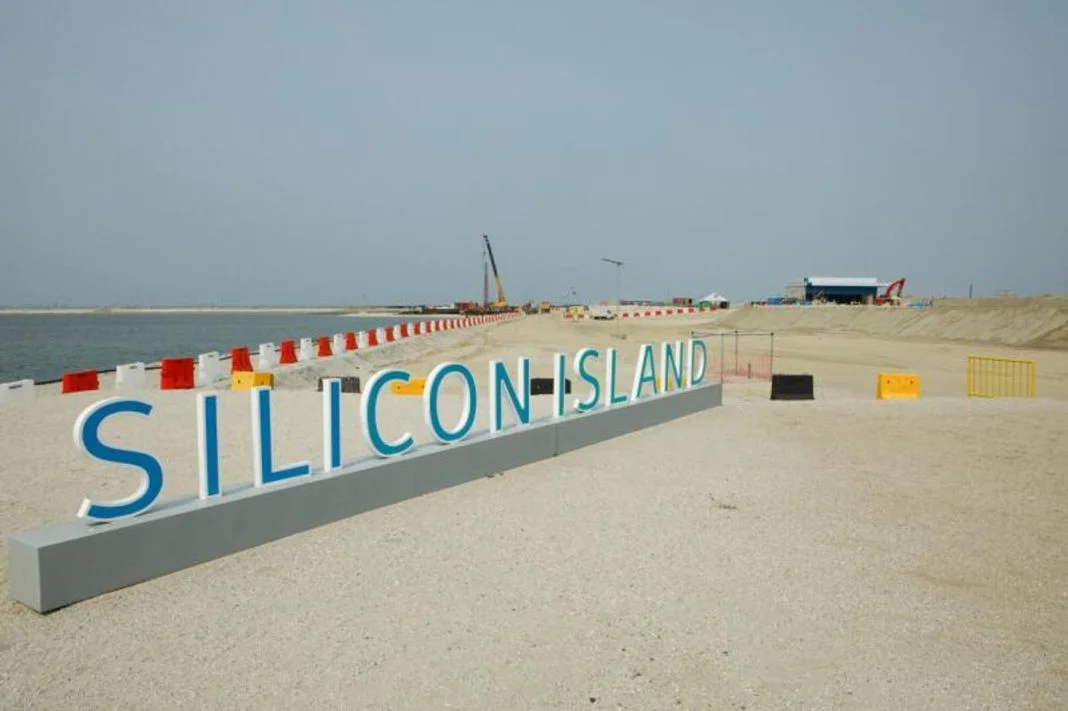
Just south of Penang, excavators are turning a stretch of blue-green sea into a man-made island. Dump trucks criss-cross freshly reclaimed sand while orange pipes carry fill pumped from dredgers offshore. When it is complete sometime next decade, the 930.77ha Silicon Island will cover almost three times the area of New York’s Central Park.
Developers expect the island to create about 220,000 jobs by 2050 and add RM1.1 trillion to Malaysia’s economic output, The Malaysian Reserve reported in a feature carried from Bloomberg News. The project answers a problem created partly by Penang’s own success. After five decades building one of South-East Asia’s leading electronics and semiconductor hubs, one of Malaysia’s smallest states is running short of land. Intel, AMD and ASE Technology Holding are among the manufacturers that have expanded around Bayan Lepas, the factory cluster near Penang’s airport that forms the heart of the country’s chip industry.
Reclamation has covered 202.3ha since works began in September 2023, according to Malay Mail. Chief Minister Chow Kon Yeow opened the Silicon Island Experience Centre on 17 October, a 2,500 sq ft gallery holding a scale model of the industrial, commercial and residential zones. The RM420 million Pan Island Link 2A contract is running on schedule, with the first section of the marine bridge from Jalan Permatang Damar Laut targeted to open by December 2028 and the full link by June 2029.
Chow said space for growth in Penang is “increasingly constrained” in an interview with Bloomberg News. “Silicon Island represents an important opportunity to build on Penang’s existing industrial strengths while positioning the state for the next phase of the global technology cycle,” he said.
The payoff is projected to be large. Silicon Island could contribute a cumulative RM1.1 trillion to Malaysia’s economic output through 2050 and draw about RM75 billion in investment, based on a Deloitte study cited by Silicon Island Development Sdn, the venture controlled by Gamuda Bhd and backed by the state government. Penang already accounts for about 5% of the world’s semiconductor exports, according to the state government.
Demand from the artificial intelligence boom is adding pressure. Malaysia Semiconductor Industry Association president Wong Siew Hai raised his forecast for the country’s electrical and electronics exports this year by about 13% to more than RM900 billion. Semiconductors make up almost three-quarters of those shipments, and Malaysia ranks as the world’s sixth-largest exporter. Some manufacturers are at capacity and looking for room to expand, Wong said.
The build-out will take time. The island needs another three to four years to be fully reclaimed and as long as 15 years to be developed, said Tan Jun Jing, deputy project director at Silicon Island Development. The first sale of industrial land is planned for early 2027, the first industrial operations for early 2029, and the project expects to break even within eight years.
At its centre sits a roughly 700-acre Green Tech Park aimed at chip design, advanced packaging and automated testing, with its first phase planned to run entirely on renewable energy. A 380m bridge will eventually connect the island to the main island. Plans also set aside about 20,000 homes on 360 acres and keep almost one-fifth of the island as green space.
Silicon Island will be the starting point for the 29.5km Mutiara Line, Penang’s first light rail system, linking the development with Bayan Lepas, the airport and George Town, with operations due by the end of 2031. A Gamuda-led consortium won the RM7.93 billion contract for the first package of civil works.
Industry interest is already arriving. Chow said responses from Taiwan and Japan have been particularly encouraging, and one Japanese prospect sent its Malaysia chief executive, then its Japan-based CEO, then its chairman to the site within two months. Competition is also growing, from Singapore, Vietnam and India abroad and from Kedah and Selangor at home. Higher land prices could narrow the pool of tenants, although land is a small part of the bill for a company spending billions on a plant, Wong said.
The development invites comparison with Forest City, the US$100 billion reclaimed project in southern Malaysia, but its backers are betting on an industry that already exists on the doorstep. Tan sees Silicon Island playing the role for Penang’s next half-century that the Bayan Lepas Free Industrial Zone played for the past 50 years. The state will own all the reclaimed land and decide how it is used, and as shareholder it is entitled to 30% of the venture’s profits.