
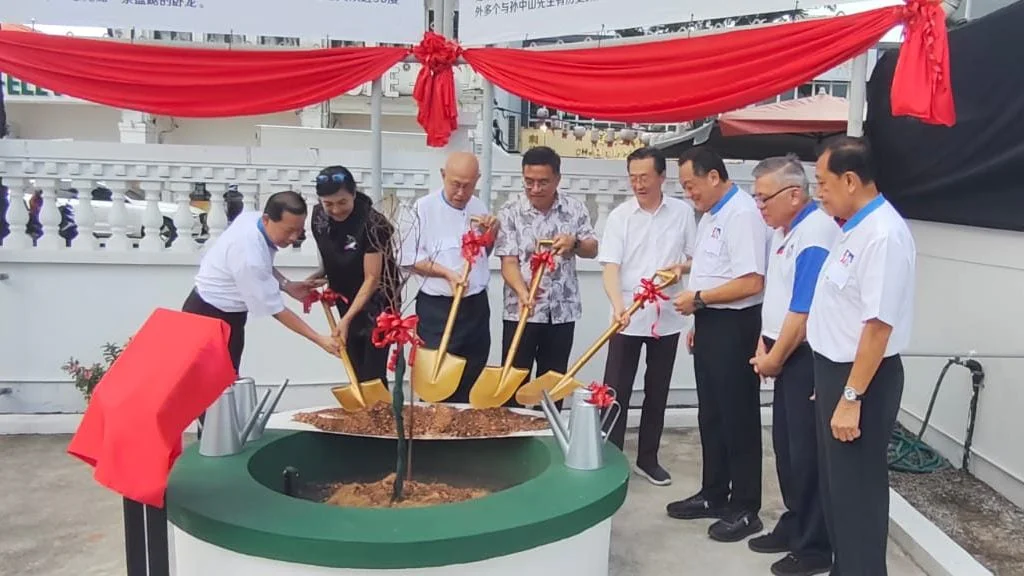
A tamarind sapling propagated from the century-old tree Dr Sun Yat Sen planted at his ancestral home in Guangdong has taken root in Penang, marking the 160th birth anniversary of the Chinese revolutionary leader.
The sapling was planted at Armenian Street Park on 4 July, opposite the Sun Yat Sen Museum at 120 Armenian Street, which served as his Southeast Asian revolutionary headquarters in 1910.
Three saplings were brought to Malaysia by Dr Sun’s great-grandniece Alexandra Sun, founder and chairman of the Sun Yat Sen Cultural Foundation. Two are planted in Penang, while the third will go to Ipoh on 7 July during the launch of the Perak Sun Yat Sen Centre.
The mother tree stands at Dr Sun’s ancestral home in Cuiheng Village, Zhongshan, Guangdong. Dr Sun planted it from seed he brought back from Hawaii in 1883, when he was a teenager studying there. The tree, now 143 years old, was listed as a nationally protected Grade I ancient tree in China’s Compendium of Ancient and Famous Trees in 2006.
“This tree is not merely a botanical specimen but a living witness to Dr Sun Yat Sen’s early revolutionary journey. It symbolises resilience, patriotism, peace and friendship,” said Penang tourism and creative economy committee chairman Wong Hon Wai during the ceremony.
Chinese Consul General in Penang Zhou Youbin said the sapling had taken root where Dr Sun once united overseas Chinese in support of China’s democratic revolution.
“As the century-old tree sends forth new shoots, may our hearts across mountains and seas look together towards the future,” he said.
Penang Island mayor Datuk A. Rajendran noted that the tamarind, also known as asam jawa, is a staple in Malay, Indian and Peranakan cuisine, making the sapling “a blend of a monumental global legacy and the everyday flavours of Penang heritage”.
Dr Sun visited Penang six times between 1905 and 1911, transforming the island into one of the Tongmenghui’s most important overseas bases. It was in Penang that he convened the historic Penang Conference, launched the fundraising campaign for the Huanghuagang Uprising, and founded Kwong Wah Yit Poh.
During those visits, he rallied support among the overseas Chinese community, raised funds, and planned revolutionary activities that contributed to the 1911 Xinhai Revolution, which overthrew the Qing dynasty.
Alexandra Sun said the saplings represent a living legacy of Dr Sun’s ideas of “Universal Compassion” and “Great Harmony”, which she described as traditional core values of Chinese civilisation that remain relevant today.
Sun Yat Sen Museum director Khoo Salma Nasution said the tree-planting ceremony forms part of the commemorations marking Dr Sun’s 160th birth anniversary and was jointly organised by the Sun Yat Sen Museum, Penang Heritage Trust, Penang Tourist Guides Association, and the Chung Shan Wooi Koon Association.
During the event, Sun also launched Salma’s book titled Sun Yat Sen and the Asian Nationalists, praising it as “the first time anyone has ever attempted to assemble such a book” that traces Dr Sun’s influence across Asia.
Students from Nanjing presented Sun with wutong leaves gathered from the Sun Yat Sen Mausoleum.
The tree-planting event precedes the relaunch of the Penang Sun Yat Sen Heritage Trail, which traces key sites linked to his revolutionary activities in George Town. The relaunch took place on 5 July at the Chung Shan Wooi Koon Association, 30 King Street.
Among those present at the tree-planting event were Penang Heritage Trust president Clement Liang, Universiti Sains Malaysia history chairman Dr Tan Chee Seng, Du Yangmei and representatives from the Nanjing Normal University WuTong Youth Charity Organisation, Datuk Seri Dr Yee Thiam Sun, and representatives of the Penang Island City Council (MBPP).