
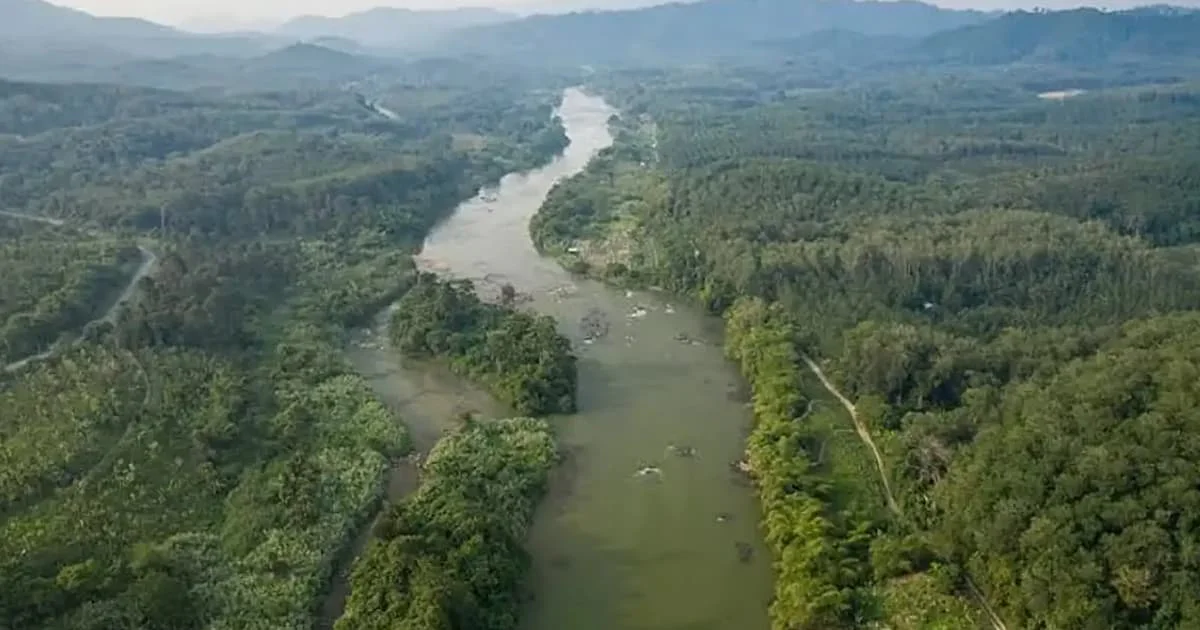
Penang’s new water deal with Perak may cost about RM400 million a year, but experts say it is likely the state’s best option given the alternatives.
Free Malaysia Today reported that Water Watch Penang president Chan Ngai Weng said the arrangement lets Penang secure a second major water source without spending billions upfront to build its own treatment plant and pipelines.
“The issue is not simply about buying the cheapest water, but about ensuring Penang has sufficient supply to support its people and economy in the coming decades,” Chan told FMT.
Penang currently relies on Sungai Muda for about 80% of its raw water. The river is shared with Kedah and has become increasingly vulnerable during dry periods. The state has no other major in-state raw water resource to tap for the 2030s.
Under the deal Malay Mail reported was signed on 15 July, Perak will build and operate a new water treatment plant and delivery system. Water will be drawn from Sungai Perak, treated at a new plant in northern Perak and piped into Penang. The agreement covers a 40-year supply period from 2032 to 2072.
At the minimum supply of 300 million litres a day, Penang’s annual payment comprises a fixed capacity charge of RM210 million plus RM1.70 for every cubic metre of treated water, totalling about RM396 million. If Penang purchases the maximum 500 million litres a day, the effective cost drops from RM3.62 to about RM2.85 per 1,000 litres.
USM economist See Kok Fong said the RM210 million capacity charge was a standard mechanism for financing major infrastructure projects. Perak will finance, build and operate the facilities, while Penang secures long-term supply without upfront investment.
See said Penang’s water tariffs would almost certainly have to increase. Commercial and industrial users would likely bear a larger share, although household tariffs could also rise gradually.
He added that Penang should ensure safeguards are in place so Perak meets its obligations on water quality and supply reliability. The charge can be reviewed every three years.
A Medium-Term Fix, Not a Permanent One
University of Nottingham Malaysia water engineering professor Teo Fang Yenn said buying treated water from another state was unusual in Malaysia.
“Most interstate transfers involve raw water, with treatment carried out by the receiving state,” she said, citing the Johor-Melaka and Pahang-Selangor schemes.
Teo said the Perak deal could help in the medium term by reducing Penang’s dependence on Sungai Muda, but the state should not rely on it alone for 40 years.
“For a long-term solution, Penang should explore other alternatives, such as coastal reservoirs, rainwater harvesting, seawater desalination and reusing wastewater,” she added.
Chan agreed, saying Penang should begin serious planning for desalination as both Kedah and Perak will require more water as they develop. He noted advances in desalination technology are making it an increasingly viable option, though costs depend on plant size, energy requirements and waste disposal.
Penang’s water consumption stood at 865 million litres a day in 2025 and is projected to exceed 1,162 million litres a day by 2032, driven by factory expansions, industrial parks and property development. The deal is the most significant water agreement in Penang’s history since the Muda River Water Scheme was commissioned in 1973.
Perak will invest RM8.4 billion in the infrastructure. PBAPP will not bear any capital expenditure, raw water fees or operational costs for the Perak-side facilities. The deal is subject to regulatory approvals from SPAN and shareholder endorsement from PBA Holdings.