
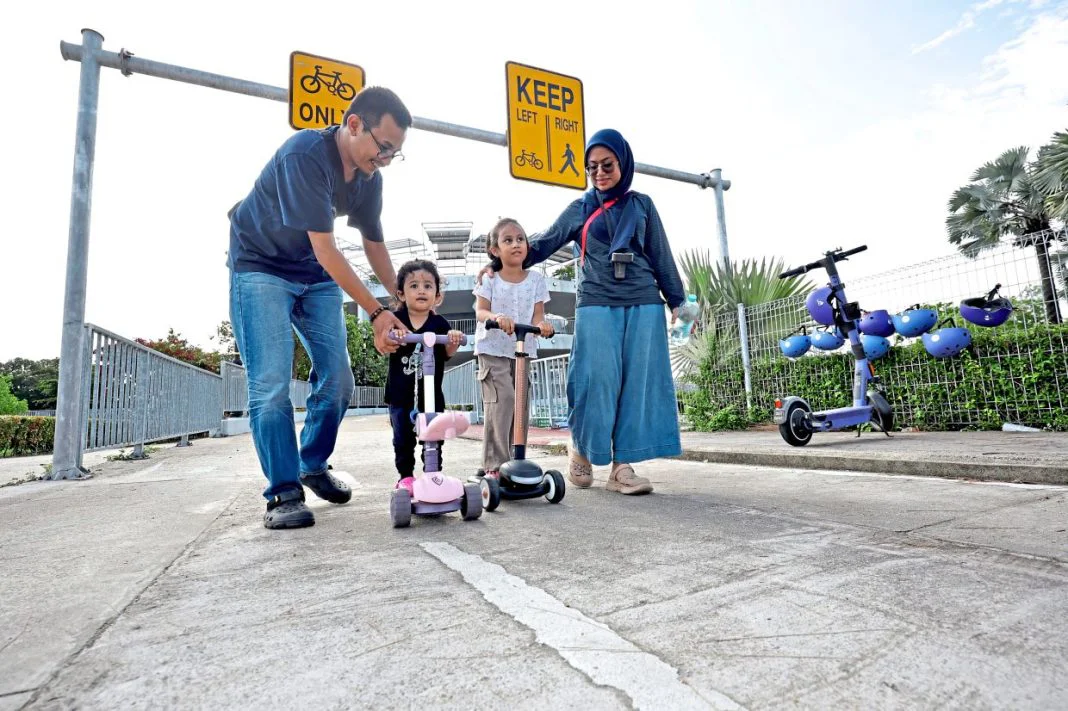
Penang built 205km of cycling routes across the island. It exceeded the 200km target set in its 2010 Bicycle Lane Master Plan. But the vision of making cycling part of everyday urban mobility now faces new challenges.
The state’s cycling movement peaked around 2016 when LinkBike launched with 25 stations and 250 bicycles across George Town. Weekend mornings saw families and tourists pedalling through heritage streets. “Bike on Friday” encouraged commuters to swap cars for two wheels. According to The Star, the enthusiasm that once defined Penang’s urban landscape has since faded.
The master plan, part of Penang2030‘s Green Connectors Project, envisioned routes spanning coastal, riverfront, heritage and recreational corridors. The state government invested RM34.8mil in a 30.2km coastal cycling route including bridges across Sungai Pinang, Sungai Nibong Kecil, Sungai Ara, Sungai Keluang, Sungai Tiram and Parit Mox.
G Club chairman Datuk Dr Lim Seh Guan, 65, who drove the Campaign For A Lane (CFAL) from 2009 to 2018, said the momentum has stalled. “Penang was once seen as a pioneer of cyclist-friendly urban planning, but that momentum has slowed down as the island has become increasingly urbanised and motorised,” he said. Cycling has shifted from a daily commute to a weekend pastime.
Penang Island City Council (MBPP) has expanded the network to 205km. Of that, 49.1km are dedicated bicycle lanes and 155.9km are shared lanes with motor vehicles. Penang Island mayor Datuk A. Rajendran said the annual maintenance budget reached RM200,000 in both 2025 and 2026 for cycling lanes, signage, barriers and lighting.
Yet infrastructure gaps remain. Dr Lim said dedicated lanes in George Town are often blocked by vehicles and delivery vans. Motorists tend to ignore bicycle boxes at traffic lights. Painted lines alone are not enough, he said. Cyclists want physical barriers or bollards to keep vehicles out of cycling lanes.
The RM8.9mil Jambatan Harapan, the country’s first spiral bridge for bicycles and pedestrians, opened in 2018. MBPP has installed 195 solar lamps, expanded CCTV coverage along routes, and equipped about 200 Rapid Penang buses to carry foldable bicycles. LinkBike recorded 291,581 members and 387,515 rides as of April 2026, covering 1.88 million kilometres.
But recent developments have removed key links. Adam Loh, 38, who used to cycle 20km to and from work each day, said the Sungai Pinang footbridge connecting Macallum and Karpal Singh Drive was demolished while construction has disrupted existing routes. “The authorities should provide alternatives before closing or demolishing existing links,” he said.
Retired businessman Sim Nai Lee, 68, said cycling events have declined. Registration fees reaching RM200 deter participants. Technology has made navigation easier, reducing the need for organised rides. “It’s all about enjoying the fellowship, staying active and spending time with family,” he said.
Cyclist Gordon Khor, 50, said the Tanjung Tokong to Pantai Malindo route remains Penang’s most attractive cycling corridor, drawing hundreds every weekend. He hopes Silicon Island will include wider cycling facilities with a full loop for commuters and recreational riders.
On the mainland, Seberang Perai City Council (MBSP) is reviewing its 2012 Bicycle Lane Master Plan which proposes 210km of cycling routes. Mayor Datuk Baderul Amin Abdul Hamid said the revised plan includes connector routes across north, central and south Seberang Perai. A further 127.8km cycling and pedestrian network is planned in Bandar Cassia and Batu Kawan Industrial Park through 2040.
MBPP infrastructure and traffic committee member Foo Yu Keong said cycling will play a bigger role once the Penang Mutiara Line LRT is completed. “MBPP will study how cycling infrastructure can be better integrated with the public transport network to strengthen first- and last-mile connectivity,” he said.
Dr Lim said e-bikes could be a game changer for Penang’s hilly terrain and hot weather. He called for safer segregated lanes, end-of-trip facilities such as showers and lockers, and incentives for electric bicycles. With cycling events evolving into family and community programmes, he said cyclists want permanent or semi-permanent car-free zones instead of occasional road closures.