
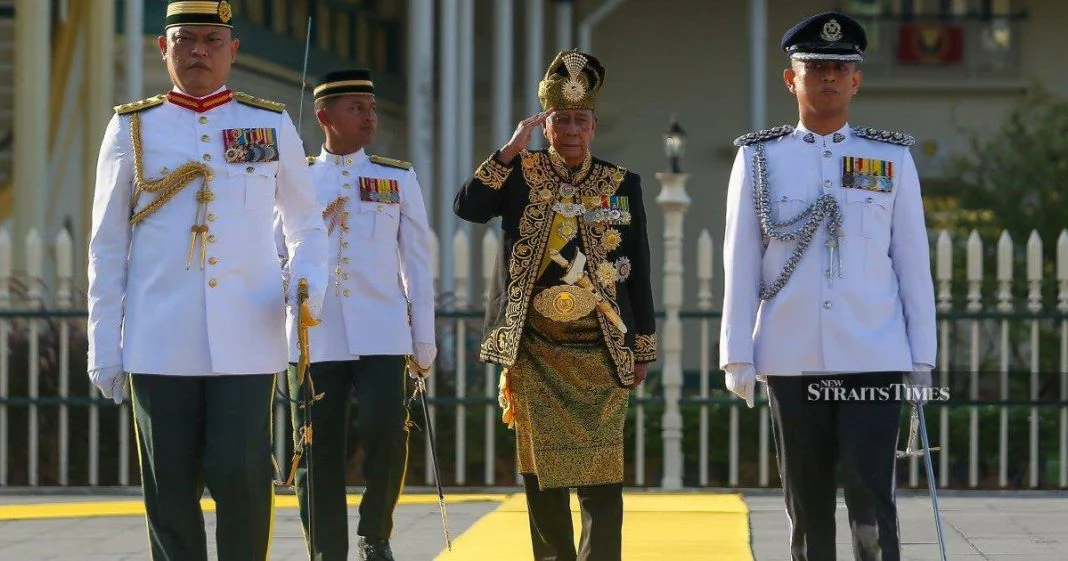
The Sultan of Kedah has called on the federal government to review the lease payment for Penang based on current rates, saying the existing payment “no longer reflects the spirit and original intent of the agreement.”
Sultan Sallehuddin Sultan Badlishah said the payment was “far lower than what it should be” in a speech at the 2026 Kedah State Awards and Honours Investiture Ceremony at Istana Anak Bukit on 5 July.
“I wish to remind all parties that the rights and sovereignty of the state of Kedah, as enshrined in the Federal Constitution of Malaysia, must be respected by all,” he said.
The Sultan also called on the federal government to cooperate in ensuring there are no administrative obstacles to Kedah’s development, including in the management of rare earth elements. He said Kedah’s rights and authority to manage and explore its natural resources must be facilitated.
“It would be a great loss if this matter fails to be implemented simply because of differences in political views and understanding, thereby disregarding the rights and needs of the state,” he said.
The intervention elevates a dispute previously driven by Menteri Besar Datuk Seri Muhammad Sanusi Md Nor into a formal royal position. Sanusi had earlier signalled plans to initiate legal proceedings over Penang before the end of 2026, saying the state’s legal team was examining the appropriate court angle.
Kedah’s claim centres on the 1791 Treaty of Peace and Friendship, under which the Kedah sultanate allowed the British East India Company to occupy Penang Island in exchange for an annual payment of 6,000 Spanish dollars. A subsequent treaty in 1800 extended the arrangement to Seberang Perai, raising the total to 10,000 Spanish dollars.
After Merdeka, the federal government paid Kedah an annual honorarium of RM10,000. In 2018, a special contribution of RM10 million per year was added, bringing the current total to RM10,010,000. Kedah demanded RM100 million annually in 2021, a figure Sanusi said should be assessed by the Valuation and Property Services Department.
Penang Chief Minister Chow Kon Yeow has rejected the claim. Speaking in the Dewan Rakyat in January, he cited the failed Sulu heirs’ bid for Sabah as precedent, arguing that historical assertions cannot override constitutional sovereignty.
“This firmly establishes that Sabah’s sovereignty is determined by the Federal Constitution, the formation of Malaysia in 1963, and international recognition,” Chow said, adding that Penang had been a sovereign state in the Federation since 1957.
Some historians have questioned whether a formal lease ever existed. Professor Datuk Ahmad Murad Merican, who has studied the history of Penang and Kedah for more than 20 years, has said no lease documents from 1786 exist, describing the narrative as a misunderstanding. He said the arrangement between Francis Light and the sultanate was considered a gentleman’s pact, and the annual honorarium was compensation for using Penang as a trading post rather than rent for a lease.
Kedah’s position maintains that the 1791 and 1800 treaties constitute formal agreements. Sanusi has distinguished the claim from the Sulu heirs’ case, noting that the Kedah Malay Sultanate still exists.
The dispute also has a resource dimension. Kedah previously demanded RM50 million annually from Penang for raw water abstracted from Sungai Muda, which provides about 84 percent of Penang’s water supply. Penang rejected the demand, citing riparian rights and the absence of any water charges in the 1985 boundary agreement. The Kedah and Penang (Alteration of Boundary) Act 1985 moved the state boundary in Seberang Perai to the middle of Sungai Muda, with Kedah receiving land and providing a water guarantee to facilitate an Asian Development Bank loan for Penang’s water supply scheme.